Second-hand prams and car seats pass or fail on these handover checks
Babies grow out of things quickly, which is why the second-hand market is full of prams that look almost new. A pram might be used daily for a year or so and then folded into the garage, so buying one second-hand can be a sensible way to save money on something you’ll only need for a short time.
Car seats are different. With a pram, what you see is mostly what you get. With a car seat, the history matters more than the look, because the damage that counts can be invisible. That doesn’t mean you should never buy one second-hand, but it does mean the checks are stricter, and some of them depend on the seller being able to answer honestly.
The checklist below covers both. It follows the same handover habit as our guide to buying a second-hand phone: check the details before you travel, check the item in person, and only then pay. Tick the rows off as you go.
Second-hand pram and car seat handover checks
0 of 14Pram or stroller
Car seat
Prams and strollers: what the mandatory standard requires
Prams and strollers sold in Australia have to meet a mandatory standard, and Product Safety Australia sets out what it requires. A few of those requirements are things you can check with your own eyes at the handover, which makes them useful for a second-hand buyer.
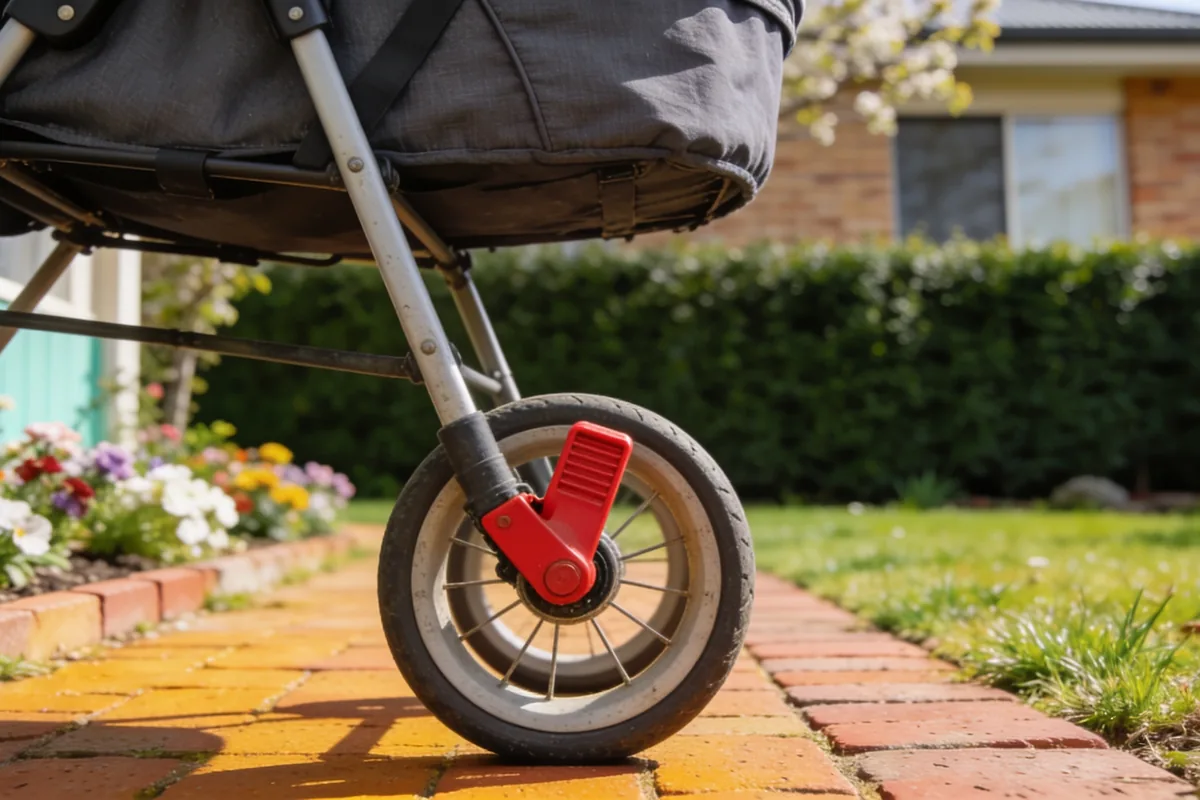
A red parking brake. The standard requires a parking device, and the part you press to put it on (the actuator) must be red. That makes the brake easy to find in a hurry. The release must also be out of reach of a child who is strapped in, so a curious toddler can’t let the brake off.
A tether strap. Prams and strollers must come with a tether strap, the loop you put around your wrist so the pram can’t roll away from you. If the strap forms a loop, the standard limits the loop to a perimeter of under 360 mm. Many second-hand prams have lost theirs, so check it is there.
A harness in each seat of a stroller. Strollers must have a harness that is permanently attached, with waist and crotch straps for each seat. Permanently attached matters: a harness that has been removed, cut or swapped for something improvised is a reason to walk away.
If a pram you’re looking at doesn’t have a red brake actuator, ask the seller where it came from before you go any further.
Pram condition checks
Once you know the pram has the basics, check that it works as it should. These checks take only a few minutes, and the seller should be happy for you to do them.
- Fold and unfold it. It should fold, unfold and lock into place without forcing. Anything that sticks, grinds or needs a knack the seller has to show you is likely to get worse.
- Test the brake on a slope. Put the brake on and give the pram a gentle push on a driveway or a slight incline. It should stay put.
- Look over the wheels and frame. Check for cracks, bends or wobbles, and spin each wheel.
- Check the fabric and buckles. Look for tears, broken clips and buckles that don’t latch firmly.
- Make sure nothing is missing. Bassinets, seat units and rain covers often get separated from the frame over time. Ask what came with it originally.
Product Safety Australia also suggests registering a product with the manufacturer, where you can, so you hear about any recalls. For a second-hand pram, that might mean contacting the maker with the model details once you’ve bought it.
Car seats: the age and the sticker
Now for the car seat, which needs more care. Kidsafe NSW publishes clear guidance for anyone buying one second-hand.
Check for the AS/NZS 1754 sticker. Child car seats used in Australia must meet the Australian Standard, AS/NZS 1754, and the information is on the seat itself. Kidsafe NSW notes that seats bought overseas that don’t meet the Australian Standard are illegal to use in Australia. If you can’t find the standard on the seat, don’t buy it.
Check the manufacture date. Kidsafe NSW recommends that car seats over 10 years old are not used, and the manufacture date is printed on the seat. It is worth being clear about what this means. The 10 years is a recommendation from Kidsafe NSW, not a legal expiry date. It is still a sensible line to follow, so find the date and do the sum before you agree on a price.
Here’s how the sum works, as an illustration. Say the date on the seat reads mid-2018. It reaches 10 years in mid-2028, so if you bought it in late 2026 you would cross Kidsafe NSW’s line about a year and a half later. If you’ll need the seat for longer than that, look for a newer date. Asking the seller to read you the date before you agree to meet saves a wasted trip.
Car seats: the history you cannot see
This is the check that makes second-hand car seats harder than prams. Kidsafe NSW advises that a seat that has been in a moderate to severe crash should not be used.
The mandatory standard backs this up. Product Safety Australia lists the labels that child restraints must carry, and one of them tells owners to destroy the restraint if it has been in a severe crash, even if no damage is visible. That last part is the key. A seat can look perfect and still have been weakened in a crash.
The required labels also say that repairs should only be done by the manufacturer or its agent, and that the restraint should not be altered or modified. So a seat with home repairs, replacement straps from somewhere else, or added padding is not one to buy.
In practice this is simple, if a little awkward. Ask the seller directly: has this seat ever been in a crash? Then think about whether you trust the answer. A family member or close friend who has owned the seat since new can tell you its whole history. A stranger who bought it second-hand themselves often can’t, however honest they are. If the seller doesn’t know, the safest choice is to keep looking.
Car seats: parts and condition
If the age, the sticker and the history all check out, look closely at the seat itself. Kidsafe NSW lists the things to check:
- All the parts. The seat should come with all its parts, including the instruction booklet. The booklet matters, because it explains how to fit and adjust that particular seat.
- The shell. Look over the plastic shell carefully, including underneath, for splits, cracks or stress marks.
- The straps. Run the straps through your fingers. They should not be frayed, worn or damaged.
Two more checks are worth adding. Make sure the upper tether strap is there, the strap that anchors the top of the seat to the car, since the mandatory standard deals with it specifically. And try the harness: it should adjust smoothly, and the buckle should release cleanly.
Recalls and getting it fitted
Before you pay for either item, search the recall list on productsafety.gov.au. You can search by brand and model, and it takes a minute or two. Product Safety Australia includes child car seats among the high-risk items it suggests inspecting before buying second-hand, and a recall check is part of that.
Once you have the seat home, think about having it fitted or checked. Some fitting services will look over a seat and install it correctly, which gives you a second pair of trained eyes on anything you might have missed.
When it’s time to pay, keep it simple and safe. Pay once you’ve seen the item, and check that the name on the account matches the seller. Our guide to marketplace scams in Australia covers the payment tricks to watch for. It also helps to know what a private sale does and doesn’t give you afterwards, which our piece on private-sale fine print explains.
Questions parents ask about second-hand gear
Are second-hand prams safe? Usually, yes, as long as the pram passes the checks above. The red brake actuator, the tether strap and the permanently attached harness are the parts of the mandatory standard you can see for yourself, and the fold, brake and wheel tests show you it still works. Add a search of the recall list and you’ve covered the main points.
Can I get a second-hand car seat checked? Some fitting services will look over a seat and fit it for you, and it’s worth doing. It doesn’t replace the history question, though. A crash can weaken a seat without leaving a mark, so a seat that looks fine to a trained eye still needs a seller who can vouch for it.
The seller says it was only a small bump. Is that okay? Kidsafe NSW draws the line at a moderate to severe crash, and the required label says to destroy a restraint after a severe crash even if no damage is visible. The difficulty is that a seller isn’t always the best judge of how bad a crash was. If the answer comes with a “but”, it’s usually safer to keep looking.
Buy the pram on looks, the car seat on history
A second-hand pram is usually a safe and sensible buy. If the brake actuator is red, the tether strap is there, the harness is permanently attached and it folds and brakes properly, you can judge most of the rest by looking.
A car seat needs more. Check for the AS/NZS 1754 sticker and a manufacture date under 10 years ago, keeping in mind that the 10 years is Kidsafe NSW’s recommendation rather than a law. Look for splits, cracks and stress marks, and check the straps and the upper tether. Most of all, buy from someone who can tell you for certain that the seat has never been in a crash. If they can’t, a new seat, or one from someone you know well, is the better choice.
Sources: Product Safety Australia, Prams and strollers mandatory standard (https://www.productsafety.gov.au/standards/prams-and-strollers); Product Safety Australia, Child restraints for use in motor vehicles mandatory standard (https://www.productsafety.gov.au/standards/child-restraints-for-use-in-motor-vehicles); Kidsafe NSW, Second hand car seats (https://www.kidsafensw.org/safety/road-safety/child-car-seats-child-restraints/second-hand-car-seats/)