Buying a second-hand fridge or washing machine: the seals, the energy label and the delivery
You’ve moved into a share house and the kitchen has nearly everything. There’s a kettle, a mismatched set of mugs, and a gap where the fridge should be, with a power point waiting. A new fridge costs a lot. A cheap one on Marketplace is twenty minutes away. The laundry might be just as empty.
Second-hand white goods are a sensible way to set up a first place. A good used fridge or washer can serve you well. A bad one becomes your problem the moment it leaves the seller’s house. Telling the two apart usually takes about twenty minutes at the seller’s door, if you know what to look at. The checklist below is that twenty minutes, and the sections after it explain each check.
Second-hand fridge or washer handover checks
0 of 14Ask the seller to have it plugged in and running before you arrive.
Both
Fridge
Washing machine
Paperwork
Your checks, not a guarantee. Private sales are generally as is.
Age and model
Before you go anywhere, ask the seller for the brand and the model number. If they don’t know it, ask for a photo of the model plate or sticker. On a fridge, it’s usually inside the door, on an inside wall or on the back. On a washing machine, try around the door opening, under the lid or on the back.
With the model number, you can look the appliance up. You’ll often find its size, its energy rating and roughly how old it is, and sometimes the original manual too. That helps in three ways. You’ll know whether it fits your space. You’ll have a sense of what it costs to run. And you’ll have the manual’s advice on moving it, which matters later.
Old doesn’t automatically mean bad. Plenty of older appliances keep going happily. Two things do change with age, though. Parts can get harder to find, so a simple repair on a very old model may not stay simple. And an older model may cost more to run than a newer one of the same size, which you’ll see on every power bill. Weigh both against the price you’re being asked.
While you have the model number handy, do a recall check as well. There’s more on that further down.
Fridge checks
The best thing you can do is ask the seller to have the fridge plugged in and running before you arrive. A fridge takes a while to get cold. If it’s been switched off, you’ll either stand there waiting or end up paying on trust, and neither is ideal.
When you get there, open the door and feel the air. It should be properly cold inside. Open the freezer too. Anything in there should be frozen solid, and if it’s empty, the walls should feel icy.
Next, the door seals, the rubber strips around the edge of each door. People used to test a seal by shutting a sheet of paper in the door and seeing whether it slid out. You can check the same thing without the paper. Open the door a little way and let it go. It should pull itself shut. Then look and run your fingers along the whole seal. It should close evenly against the cabinet all the way round, with no gaps, tears or hard, cracked sections. A seal that doesn’t close properly lets the cold out, and the fridge has to work harder to make up for it.
Listen for a while. A running fridge hums, and you’ll hear the compressor start and stop from time to time. That’s normal. A loud rattle, a grinding noise or constant clicking isn’t.
Look inside for water pooling at the bottom, heavy frost building up on the back wall or in the freezer, and any mould. Have a sniff, too. Some smells wipe out with a bit of bicarb. Others have soaked into the plastic and stay.
Washing machine checks
A washing machine is hard to judge while it’s sitting still, so try to see it work. Ask whether you can run a short cycle while you’re there. If that’s too long, ask for at least a fill and a spin. A seller with nothing to hide will usually say yes.
While it runs, watch and listen. It should fill without fuss, the drum should turn smoothly, and the spin shouldn’t sound like a box of spanners. Some noise during a spin is normal. Grinding, banging or squealing isn’t.
With the machine off, turn the drum by hand. It should move freely, without grinding or catching. On a front loader, look closely at the rubber door seal, folding it back gently to see inside the folds. Mould is a reason to look harder, and tears or holes can mean leaks.
Check the hoses at the back for cracks, bulges or rubber that has gone stiff. Look underneath and around the base for signs of water, such as stains, rust or a damp floor. Ask how it drains, and check that the drain hose isn’t split.
Finally, ask about the transit bolts. These hold the drum still while a front loader is being moved. If the seller still has them, take them with the machine. Your manual will say whether you need them for the trip, and how to fit them. Without them, the drum can knock around in the back of a ute.
The energy label on an older model
Fridges and washing machines in Australia usually carry an Energy Rating Label, the sticker with the stars. The Australian Government’s Energy Rating website explains how to read it.
The label tells you two things. The star rating shows how energy efficient the appliance is, and more stars means more efficient. The figure in kilowatt hours per year, shown as kWh, tells you how much energy it’s expected to use in a year.
Compare like with like. Energy Rating advises comparing appliances of a similar size and with similar features. A big fridge and a small fridge with the same stars won’t use the same energy, so the kWh figure is often the more useful number to look at.
Older models come with a catch. The ratings have been revised over time, so the stars on an old label may not compare with the stars on a new one. An older fridge with plenty of stars isn’t necessarily as efficient as a new fridge with the same rating.
To get a rough idea of what it will cost to run, take the kWh per year figure and multiply it by the price per kWh on your own power bill. That gives you a yearly estimate. It won’t be exact, but it’s a handy way to compare two second-hand options, or a used fridge against a new one.
Getting it home
Before you say yes, get the tape measure out. Measure the appliance first. Then measure every doorway, hallway and staircase it has to pass through, at the seller’s place and at yours. Measure the fridge cavity or the laundry space it’s going into as well, and check the manual for any space it needs around it. It’s easy to buy a fridge that won’t make it round the corner at the top of the stairs.
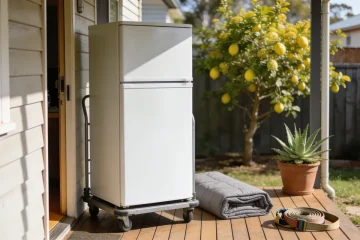
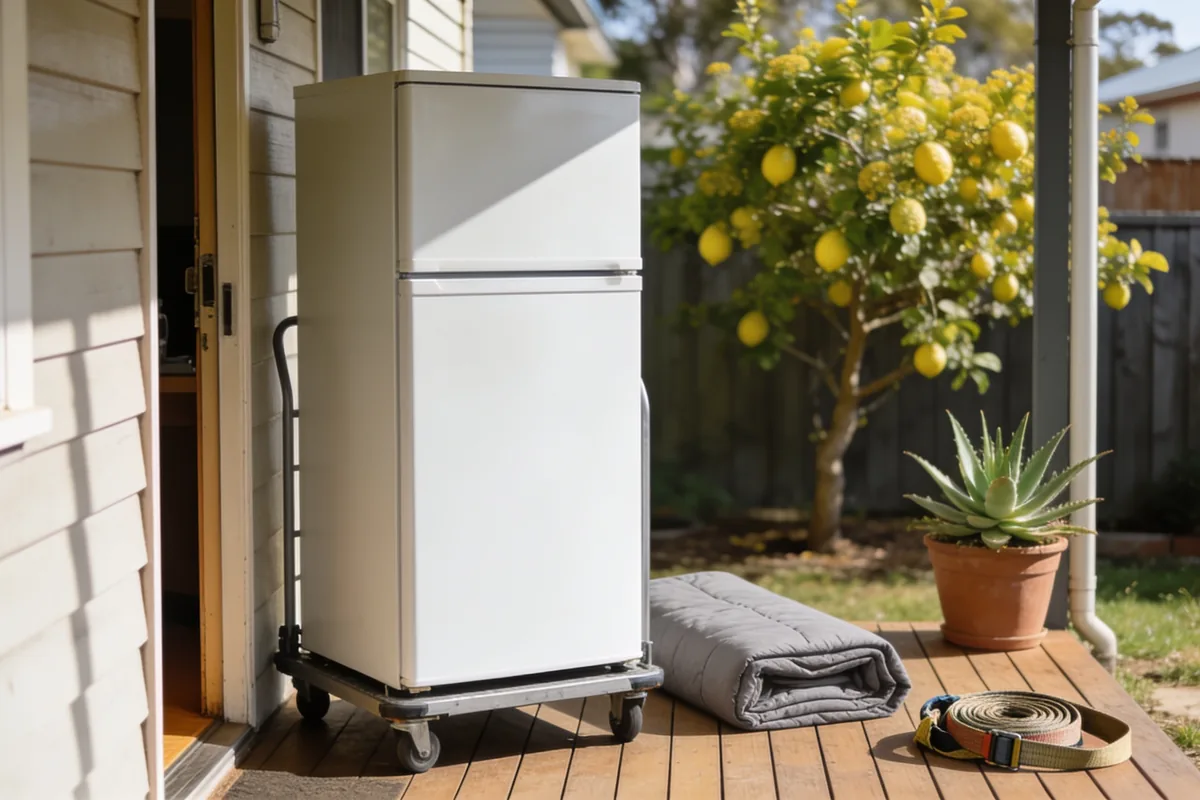
Then plan the move. You’ll want a ute, a van or a trailer, straps to hold the appliance steady, and a hand trolley if you can borrow one. And you’ll need two people. Fridges and washing machines are heavy and awkward, and stairs make everything harder. If you don’t have a ute, ask the seller whether they can help with delivery, or whether a friend with a trailer owes you a favour. Some people hire a van for a few hours, which is often easier than it sounds.
Before you set off, clear a path at home. Move the couch, prop the doors open and take the empty boxes out of the hallway. Carrying a fridge is not the moment to find out the side gate is locked.
How you carry a fridge matters. Many manuals say a fridge should travel upright, so check the manual for your model. Strap it so it can’t tip or slide, and wrap it in a blanket to protect it.
Once it’s home, don’t switch it straight on. Manufacturers’ manuals generally say a fridge that has been moved should stand for a while before it’s turned on. How long depends on the model, so check the manual rather than guessing.
For a front loader, fit the transit bolts for the move if you have them and the manual calls for it. Then take them out again before the first wash.
Private sale or reconditioned shop
Second-hand white goods mostly come from two places: private sellers and shops that sell reconditioned appliances.
A reconditioned appliance shop may offer a warranty, and as a business it has obligations that a private seller doesn’t. Shops can be a bit exxy by comparison, but some buyers decide a warranty is worth paying for. If you buy from one, ask what the warranty covers and for how long, and get it in writing.
A private sale is different. A private seller doesn’t give you the consumer guarantees you’d get from a business, so private sales are generally as is. That’s why the handover checks matter so much. They’re your protection. Our guide to private-sale fine print explains what you do and don’t get from a private seller.
Either way, get a receipt with the seller’s name, the model and the price.
And do the recall check. Product Safety Australia publishes product recalls, and you can search by brand and model. It’s the same habit we suggest for second-hand prams and car seats, and it only takes a minute or two.
If your new-to-you fridge is replacing an old one, the old one has to go somewhere. Our guide to hard rubbish collection explains how council pickups work and what they’ll take.
Cold before cash
A second-hand fridge or washing machine can be a great buy for a first home. Ask for the model number and look it up, and check it against the recall list. Ask the seller to have the fridge running before you arrive, and run the washer if you can. Check the seals, listen to the noises and look at the floor underneath. Read the energy label carefully if the model is old. Measure everything, bring a friend and a trolley, and let the fridge stand before you switch it on. Then pay, and keep the receipt.
Sources: Energy Rating, Understand the Energy Rating Label (https://www.energyrating.gov.au/consumer-information/understand-energy-rating-label); Product Safety Australia, Recalls (https://www.productsafety.gov.au/recalls)